
0110 min
Current Affairs Made Easy: two-pager notes
Two hand-written pages every day, close to 180 topics a month.
- Four current affairs and two static topics a day
- Related PYQs marked
- Key lines highlighted for you
English and Hindi editions · print-friendly
Most aspirants read the news every day and lose most of it within a month, because nothing brings it back. Compass gives you about an hour of daily reading, then revisits the same topics weekly, monthly and once more before the exam, so what you read is still there when the paper arrives.An hour of daily reading, revisited weekly, monthly and before the exam, so it stays with you till the paper.
₹3,999₹8,999For the first 100 students
Course walkthrough
How the daily hour, weekly MCQs and 365+ fit together
The walkthrough video goes live with the page.
Watch how the course runs before you log in
10mTwo-pager notes4 current + 2 static topics
15+Revision MCQsevery week
3Newspapers coveredHindu, Express, PIB
Start with your problem
Pick the problems that describe your preparation right now. The board shows which of the ten components is built to fix each one.
The 10 components
5 match your answers
You want one routine that serves both Prelims and Mains, in English or Hindi, and can give it about an hour every day.
You're looking for more reading material to collect. The course is a daily routine, and it only works if you show up for it.
How it works
Each rhythm does one job. Daily keeps you up to date, weekly checks what stayed, monthly organises it, and yearly shrinks it for the exam. Pick a rhythm to see what it includes.
About one hour
Keeps you current without taking over the day.
about 60 minutes in total
The longer rhythms catch what the shorter ones drop, so one bad week doesn't end the plan.
No component stands alone. A story from the morning paper turns up again in your notes, your workbook and finally a test question.
What's included
Grouped by how often you use them, with the time each one takes.
About one hour
Two hand-written pages every day, close to 180 topics a month.
The actual articles from The Hindu, Indian Express and PIB, with the important lines already marked.
Ends each day by asking you to recall what you read instead of reading it again.
One round
At least fifteen questions on the week's topics, about sixty a month. They arrive a few days after the reading, so they test what you kept rather than what you saw yesterday.
One sitting
One file for the whole month, laid out for re-reading so you don't rebuild the month from dozens of PDFs.
Prelims and Mains questions on that month's topics.
The month condensed into cards you can revise in about a minute each, carrying fresh examples so your answers stand apart.
Last stretch
The full year at half the pages with no topic cut, compiled by rankers who have sat Mains and the interview.
For schemes, sequences and similar-looking numbers that don't stay in memory from reading alone.
Three timed papers with 300 high-probability current affairs questions in all, attempted under exam conditions.
Learning outcomes
Six things you should be able to do once the routine is running, and the components that build each one.
A same-day quiz and a weekly test set a few days later make you retrieve the topic twice before it fades.
010304
Facts for Prelims and material for Mains arrive separated, so your reading time goes into learning.
02
The workbook makes you write on the month's topics, and the flashcards give you fresh examples so your answer reads differently from the rest.
0607
The 365+ summaries cut the year to half the pages without dropping topics, and also cover any month you missed.
08
Timed Knockout papers show how you do on current affairs under exam pressure.
10
Your workbook answers, marks and times build a record you can look back on, instead of a feeling that you're on track.
06
The two-pager notes hold a full year in a fraction of the pages a stack of monthly magazines takes. For Prelims 2027 their coverage is widened to 18 months.
Bars drawn to scale. Magazine figure is approximate.
See before you enroll
Five of the ten components are files you read and write on. Below are six real pages from them, not mockups.
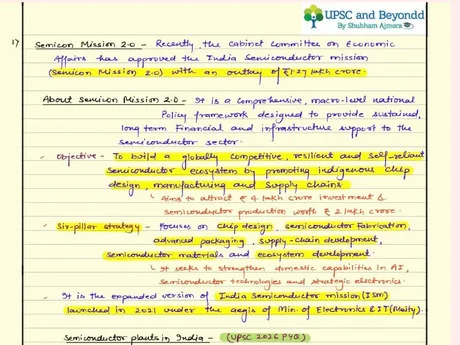
Two hand-written pages a day, PYQs marked and key lines highlighted.

The actual article from The Hindu, Indian Express or PIB, already marked up.
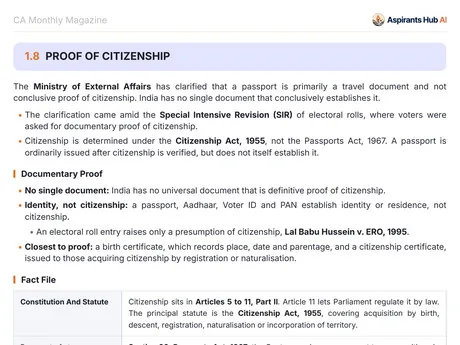
The whole month in one file, made for re-reading.
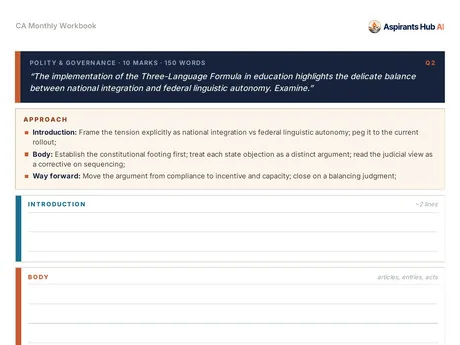
Space for your answers, a grid for marks, and worked solutions.
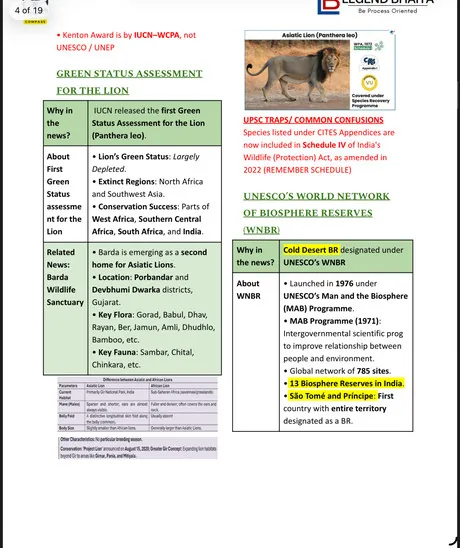
The year for Prelims at half the pages, with common UPSC traps flagged.
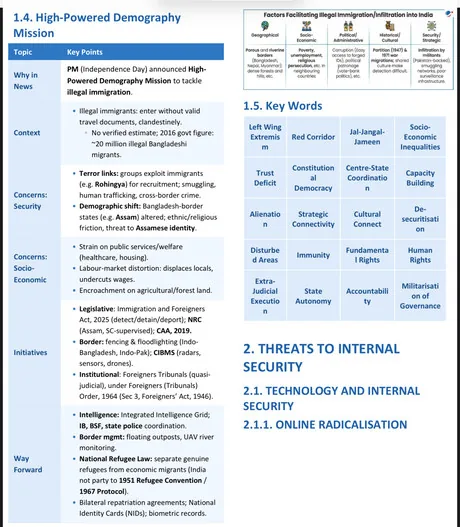
Topic tables, keywords and committees, laid out for writing answers.
Not shown here: the Knockout tests, mnemonic videos, Mains flashcards, weekly MCQs and the daily quiz.
Prelims 2026 check
The course makes no promise about marks. After Prelims 2026, the team went through the paper question by question and matched it against what students had already received, one component at a time.
Two-pager notes
17 + 8 partly
Seventeen fully and eight partly solvable from a year of notes that runs to 273 pages.
Newspaper snippets
19+ + 22 in Mains
At least nineteen in Prelims, plus twenty-two that appeared in Mains.
Knockout test series
10 of 300
Ten of the 300 Knockout questions came up in the Prelims paper itself.
The matches were published question by question, in public. If another institute shows you a hit count, ask for the question-by-question list behind it.
AIR 47 also used the newspaper snippets and flashcards.
Details and fee
Everything you need to decide, in one place.
Current Affairs Compass
First 100 students₹3,999₹8,999
Introductory fee for the first 100 students. The regular fee is ₹8,999. One programme, no tiers.
Log in to enrollSign in on aspirantshub.ai and pick Current Affairs Compass from the plans.
An hour a day sounds small, which is exactly why it gets skipped. The course filters the material, sets the routine and supplies the tests. Opening the workbook on a tired day in March is still up to you.
FAQs
Still unsure? Post your doubt on Telegram at t.me/UPSCand_Beyond, or call admissions on +91 92172 66679.
Log in to enrollAbout an hour. Roughly ten minutes go to the two-pager notes and up to forty five minutes to the newspaper snippets, and the daily quiz closes the day. The weekly, monthly and yearly components sit outside that hour.
The newspaper snippets are the actual articles, cut from The Hindu, Indian Express and PIB, with the key lines highlighted. The two-pager notes are written by a team that reads 20 to 30 sources for about three hours every morning.
Yes. Current Affairs Compass comes in English and Hindi editions, and both are print-friendly.
Yes. Prelims facts and Mains material are separated before they reach you. The workbook covers each month's topics with questions for both stages, the Mains flashcards and Mains 365+ are built for answer writing, and PT 365+, the mnemonic videos and the Knockout tests are aimed at Prelims.
The longer rhythms are built to catch what the shorter ones drop. The weekly revision MCQs pick up missed days, and the PT 365+ and Mains 365+ summaries let you catch up on a missed month.
The weekly revision MCQs have fifteen or more questions each week, around sixty a month. The monthly workbook adds questions for both Prelims and Mains on that month's topics, with full solutions, and the Current Affairs Knockout test series has three hundred questions across three timed papers.
Not fully. Lakshya CSE doesn't include three of its components: the monthly magazine, the workbook and the Current Affairs Made Easy notes. If you're a Lakshya student, you can add all three as an upgrade.
Rs 3,999 for the first 100 students; the regular fee is Rs 8,999. There is one programme, and it includes all ten components in both English and Hindi.
No. After Prelims 2026 the team matched the paper against Compass material question by question and published the results in public. The course gives you the filtered material, the routine and the tests, but you still have to put in the hour every day.
Log in on aspirantshub.ai and choose Current Affairs Compass from the plans. If you have a question first, post it on Telegram at t.me/UPSCand_Beyond or call admissions on +91 92172 66679.
Read · Recall · Revise · Test
About an hour a day, revisited every week, every month and once more before the exam. ₹3,999 for the first 100 students.
Log in to enrollDoubts? Ask on Telegram · Admissions +91 92172 66679
Fix the process, result may follow.