Question 1Calibrate
A previous year question
Write a question UPSC has already asked, then check it against our complete handwritten model answer to see how that theme is meant to be handled.
A full handwritten model answer
Batch started Tue 15 September
One GS topic a day, three answers, instant AI feedback. 177 answers across GS1 to GS4 by 23 December.
Download the course brochurePDF · 12 pages · full day-by-day schedule₹3,999+ GSTJoining late? Every earlier day stays open.
3questions a dayPYQ, topper, new
177answers by 23 DecGS1 to GS4
AIfeedback, instantlyon every answer
Is it for you
Built for UPSC CSE 2027 aspirants who know the syllabus but have not yet made answer writing a daily habit. Pick the problems that sound like you.
One topic, three answers
Every answer-writing day takes one topic from the GS syllabus and sets three questions on it: one to calibrate, one to imitate and one to stretch.
Write a question UPSC has already asked, then check it against our complete handwritten model answer to see how that theme is meant to be handled.
A full handwritten model answer
Answer it yourself first. Then study the exact answer that scored in a 130+ copy: its opening, its structure and its enrichment.
The topper's actual answer, from CSE 2025 copies
A question you have not seen, on the same topic, written against the clock. Handling the unfamiliar is what the exam tests.
Instant AI feedback on your attempt
The daily loop
Every answer is checked by Aspirants Hub's AI evaluation, the system 80+ rankers used in CSE 2025. Each report feeds the next day's writing, so the gains add up over 59 days.
Real samples
These are the pages a Tapasya day delivers. Open any page to read it at full size.
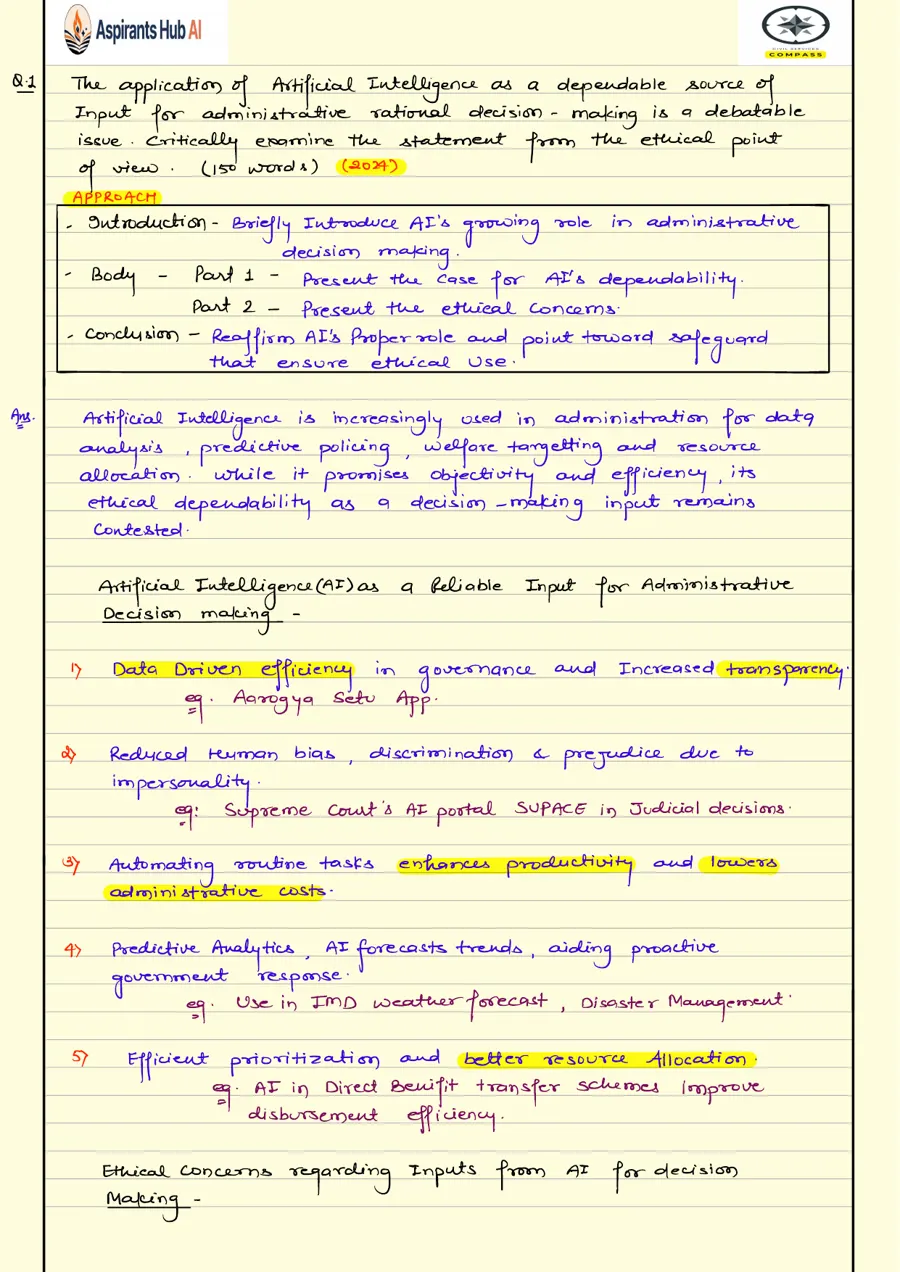
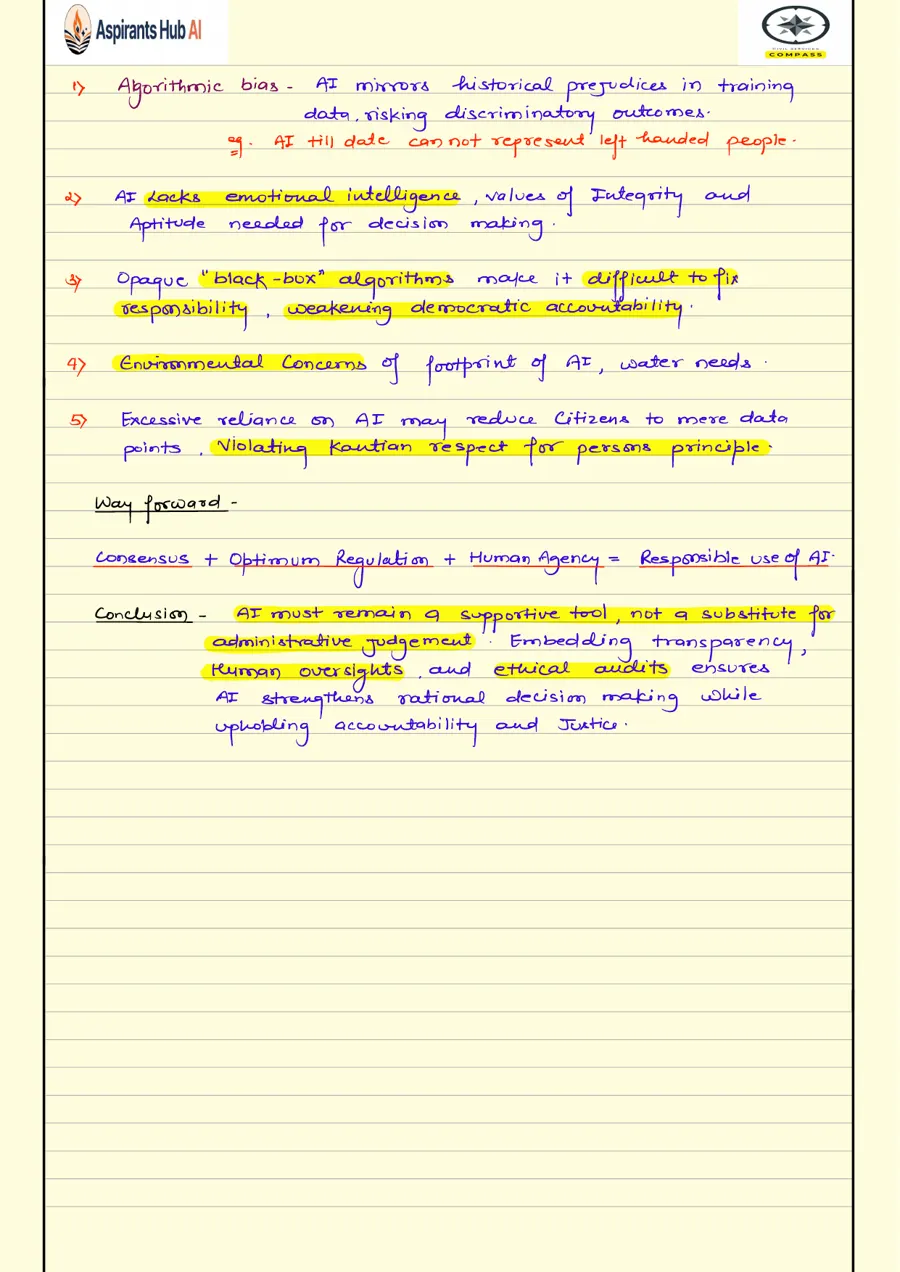
Question 1 · PYQ
A GS4 question on artificial intelligence as an input for administrative decisions, answered in full: approach box, introduction, both sides of the argument, a way forward and a conclusion. Every PYQ in the course comes with one.
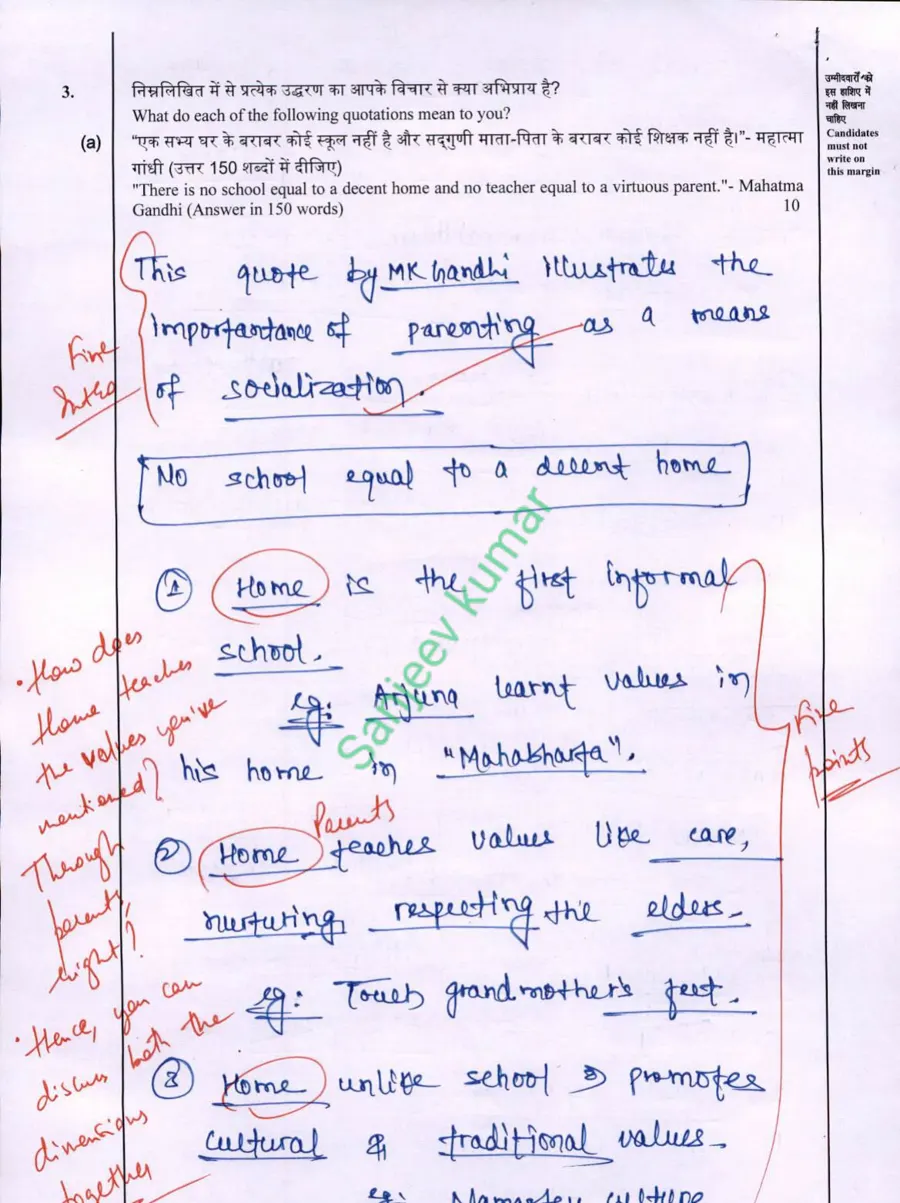
Question 2 · Topper copy
A GS4 quotation question answered by a topper, with review remarks in the margin. You write first, then study it. Copies come from 2025 toppers, including Monika Srivastava (132) and AR Rajah (138).
The 100-day plan
All 11 subjects follow the same four-part cycle, and the next subject opens the day after the last one closes. Tap any day to see what is planned for it.
Prepare the subject's topics from your own sources and add value addition.
An evening session on each reading day: how the syllabus becomes questions and what to leave out.
Three questions a day on that topic, each evaluated as soon as you submit.
Closes every subject except the short Ethics case-studies block; the next subject opens the day after.
Learning outcomes
Completing every day of the course adds up to the practice below. Each figure comes straight from the schedule.
Written answers on all 59 topics across GS1 to GS4, not only the papers you are comfortable with.
59 PYQs written and checked against complete handwritten model answers.
59 topper-copy answers taken apart for their openings, structure and enrichment.
59 new questions written against the clock, the situation the exam puts you in.
An instant evaluation report on every answer, each pointing at the next change.
A revision day closing ten of the eleven subjects, so earlier topics stay fresh.
Day-by-day timetable
Pick a subject to see each day's plan. Topics follow the UPSC Mains syllabus, from GS4 in September to GS1 in December.
11 subjects · pick one to see its days
Subject 1 of 11 · GS4
Tue 15 Sep - Sat 26 Sep
| Date | Plan for the day | Brainstorming (free · Zoom) |
|---|---|---|
| Tue 15 Sep | Subject opens: begin reading from your own sources | |
| Wed 16 Sep | Reading day 1: start the topics from your sources | Session 1 |
| Thu 17 Sep | Reading day 2: complete the topics and add your value addition | Session 2 |
| Fri 18 Sep | 1/8Ethics and the human interface: essence, determinants, consequences and dimensions; ethics in private and public relationships | |
| Sat 19 Sep | 2/8Human values: lessons from leaders, reformers and administrators; the role of family, society and educational institutions | |
| Sun 20 Sep | 3/8Attitude: content, structure and function; its link with thought and behaviour; moral and political attitudes; social influence and persuasion | |
| Mon 21 Sep | 4/8Aptitude and foundational values for civil service: integrity, impartiality, objectivity, dedication, empathy and compassion for weaker sections | |
| Tue 22 Sep | 5/8Emotional intelligence: concepts, utility and application in administration and governance | |
| Wed 23 Sep | 6/8Contributions of moral thinkers and philosophers from India and the world | |
| Thu 24 Sep | 7/8Public service values and ethics in public administration: dilemmas, laws and conscience, accountability, ethics in international relations, corporate governance | |
| Fri 25 Sep | 8/8Probity in governance: RTI, codes of ethics and conduct, citizen's charters, work culture, service delivery, public funds and corruption | |
| Sat 26 Sep | Revision day |
Subject 2 of 11 · GS4
Sun 27 Sep - Thu 01 Oct
| Date | Plan for the day | Brainstorming (free · Zoom) |
|---|---|---|
| Sun 27 Sep | Reading day 1: start the topics from your sources | Session 3 |
| Mon 28 Sep | Reading day 2: complete the topics and add your value addition | Session 4 |
| Tue 29 Sep | 1/3A case-study framework, applied to personal and professional dilemmas | |
| Wed 30 Sep | 2/3Administrative dilemmas: corruption, political pressure and resource allocation | |
| Thu 01 Oct | 3/3Full-length mixed cases: society, environment, disaster and international relations | |
| Fri 02 Oct | Day off: Gandhi Jayanti |
Subject 3 of 11 · GS3
Sat 03 Oct - Mon 12 Oct
| Date | Plan for the day | Brainstorming (free · Zoom) |
|---|---|---|
| Sat 03 Oct | Reading day 1: start the topics from your sources | Session 5 |
| Sun 04 Oct | Reading day 2: complete the topics and add your value addition | Session 6 |
| Mon 05 Oct | 1/7Planning, mobilisation of resources, growth, development and employment | |
| Tue 06 Oct | 2/7Inclusive growth and the issues it raises; government budgeting | |
| Wed 07 Oct | 3/7Effects of liberalisation; industrial policy and industrial growth | |
| Thu 08 Oct | 4/7Infrastructure: energy, ports, roads, airports and railways; investment models | |
| Fri 09 Oct | 5/7Cropping patterns, irrigation, storage, transport and marketing of farm produce; e-technology for farmers | |
| Sat 10 Oct | 6/7Farm subsidies and MSP; PDS; buffer stocks and food security; technology missions; economics of animal rearing | |
| Sun 11 Oct | 7/7Food processing: scope, location, upstream and downstream needs, supply chains; land reforms in India | |
| Mon 12 Oct | Revision day |
Subject 4 of 11 · GS3
Tue 13 Oct - Wed 21 Oct
| Date | Plan for the day | Brainstorming (free · Zoom) |
|---|---|---|
| Tue 13 Oct | Reading day 1: start the topics from your sources | Session 7 |
| Wed 14 Oct | Reading day 2: complete the topics and add your value addition | Session 8 |
| Thu 15 Oct | 1/5Science and technology in everyday life; achievements of Indians; indigenisation and new technology | |
| Fri 16 Oct | 2/5IT, space, computers, robotics, nanotechnology and biotechnology; IPR issues | |
| Sat 17 Oct | 3/5Conservation and biodiversity; environmental pollution and degradation | |
| Sun 18 Oct | 4/5Environmental impact assessment and environmental governance; links to climate action | |
| Mon 19 Oct | 5/5Disasters and disaster management | |
| Tue 20 Oct | Day off: Dussehra | |
| Wed 21 Oct | Revision day |
Subject 5 of 11 · GS3
Thu 22 Oct - Wed 28 Oct
| Date | Plan for the day | Brainstorming (free · Zoom) |
|---|---|---|
| Thu 22 Oct | Reading day 1: start the topics from your sources | Session 9 |
| Fri 23 Oct | Reading day 2: complete the topics and add your value addition | Session 10 |
| Sat 24 Oct | 1/4Development and the spread of extremism (LWE) | |
| Sun 25 Oct | 2/4External state and non-state actors; security in border areas; links between organised crime and terrorism | |
| Mon 26 Oct | 3/4Communication networks, media and social networking; cyber security; money laundering | |
| Tue 27 Oct | 4/4Security forces and agencies and their mandates | |
| Wed 28 Oct | Revision day |
Subject 6 of 11 · GS2
Thu 29 Oct - Wed 11 Nov
| Date | Plan for the day | Brainstorming (free · Zoom) |
|---|---|---|
| Thu 29 Oct | Reading day 1: start the topics from your sources | Session 11 |
| Fri 30 Oct | Reading day 2: complete the topics and add your value addition | Session 12 |
| Sat 31 Oct | 1/7The Constitution: historical underpinnings, evolution, features, amendments, key provisions and basic structure | |
| Sun 01 Nov | 2/7Functions of the Union and the states; federal issues; devolution of powers and finances to local levels | |
| Mon 02 Nov | 3/7Separation of powers; dispute-redressal bodies; comparison with other constitutions | |
| Tue 03 Nov | 4/7Parliament and state legislatures: structure, functioning, conduct of business, powers and privileges | |
| Wed 04 Nov | 5/7Executive and judiciary: structure and functioning; ministries and departments; pressure groups | |
| Thu 05 Nov | 6/7Representation of People's Act; appointments to constitutional posts; constitutional bodies | |
| Fri 06 Nov | 7/7Statutory, regulatory and quasi-judicial bodies | |
| Sat 07 Nov | Day off: Diwali break (Dhanteras) | |
| Sun 08 Nov | Day off: Diwali | |
| Mon 09 Nov | Day off: Diwali break (Govardhan Puja) | |
| Tue 10 Nov | Day off: Diwali break (Bhai Dooj) | |
| Wed 11 Nov | Revision day |
Subject 7 of 11 · GS2
Thu 12 Nov - Sat 21 Nov
| Date | Plan for the day | Brainstorming (free · Zoom) |
|---|---|---|
| Thu 12 Nov | Reading day 1: start the topics from your sources | Session 13 |
| Fri 13 Nov | Reading day 2: complete the topics and add your value addition | Session 14 |
| Sat 14 Nov | 1/6Government policies and interventions: issues in design and implementation | |
| Sun 15 Nov | 2/6Development processes and the development industry: NGOs, SHGs, donors, charities and other stakeholders | |
| Mon 16 Nov | Day off: Chhath Puja | |
| Tue 17 Nov | 3/6Welfare schemes for vulnerable sections, and the laws, institutions and bodies that protect them | |
| Wed 18 Nov | 4/6The social sector: health, education and human resources | |
| Thu 19 Nov | 5/6Poverty and hunger | |
| Fri 20 Nov | 6/6Transparency and accountability; e-governance; citizens' charters; the role of civil services in a democracy | |
| Sat 21 Nov | Revision day |
Subject 8 of 11 · GS2
Sun 22 Nov - Sun 29 Nov
| Date | Plan for the day | Brainstorming (free · Zoom) |
|---|---|---|
| Sun 22 Nov | Reading day 1: start the topics from your sources | Session 15 |
| Mon 23 Nov | Reading day 2: complete the topics and add your value addition | Session 16 |
| Tue 24 Nov | Day off: Guru Nanak Jayanti | |
| Wed 25 Nov | 1/4India and its neighbourhood | |
| Thu 26 Nov | 2/4Bilateral, regional and global groupings and agreements that involve or affect India | |
| Fri 27 Nov | 3/4How the policies of developed and developing countries affect India; the Indian diaspora | |
| Sat 28 Nov | 4/4Major international institutions, agencies and fora: structure and mandate | |
| Sun 29 Nov | Revision day |
Subject 9 of 11 · GS1
Mon 30 Nov - Tue 08 Dec
| Date | Plan for the day | Brainstorming (free · Zoom) |
|---|---|---|
| Mon 30 Nov | Reading day 1: start the topics from your sources | Session 17 |
| Tue 01 Dec | Reading day 2: complete the topics and add your value addition | Session 18 |
| Wed 02 Dec | 1/6Art forms, literature and architecture from ancient to modern times | |
| Thu 03 Dec | 2/6Modern India from the mid-18th century: events, personalities and issues; socio-religious reform movements | |
| Fri 04 Dec | 3/6The freedom struggle: its stages and its contributors from across the country | |
| Sat 05 Dec | 4/6Consolidation and reorganisation after independence | |
| Sun 06 Dec | 5/6World history: industrial revolution, world wars, colonisation, decolonisation and redrawn boundaries | |
| Mon 07 Dec | 6/6Political philosophies (communism, capitalism, socialism) and their effects; a PYQ-heavy wrap-up | |
| Tue 08 Dec | Revision day |
Subject 10 of 11 · GS1
Wed 09 Dec - Tue 15 Dec
| Date | Plan for the day | Brainstorming (free · Zoom) |
|---|---|---|
| Wed 09 Dec | Reading day 1: start the topics from your sources | Session 19 |
| Thu 10 Dec | Reading day 2: complete the topics and add your value addition | Session 20 |
| Fri 11 Dec | 1/4Salient features of Indian society; the diversity of India | |
| Sat 12 Dec | 2/4The role of women and women's organisations; population and related issues | |
| Sun 13 Dec | 3/4Poverty and development; urbanisation, its problems and remedies | |
| Mon 14 Dec | 4/4Effects of globalisation; social empowerment, communalism, regionalism and secularism | |
| Tue 15 Dec | Revision day |
Subject 11 of 11 · GS1
Wed 16 Dec - Wed 23 Dec
| Date | Plan for the day | Brainstorming (free · Zoom) |
|---|---|---|
| Wed 16 Dec | Reading day 1: start the topics from your sources | Session 21 |
| Thu 17 Dec | Reading day 2: complete the topics and add your value addition | Session 22 |
| Fri 18 Dec | 1/5World physical geography; geomorphology; earthquakes, tsunamis, volcanoes and cyclones | |
| Sat 19 Dec | 2/5Climatology and oceanography; changes in water bodies, ice caps, flora and fauna | |
| Sun 20 Dec | 3/5Distribution of key natural resources across the world, South Asia and India | |
| Mon 21 Dec | 4/5What decides where primary, secondary and tertiary industries are located | |
| Tue 22 Dec | 5/5Indian geography mapping, integrated with PYQs | |
| Wed 23 Dec | Revision day |
Choose your course
Tapasya is the writing half of Mains Ready by December, offered on its own. If writing is your only gap, it is enough.
Writing only
₹3,999+ GST
For aspirants whose gap is answer writing. Late joiners get every earlier day.
The full programme
₹9,999+ GST₹19,999
For aspirants who also need notes, tests and a mentor. Runs on a fixed calendar and closes in January.
Our one-pager notes and value addition for every subject, used by multiple rank holders, come with Mains Ready by December or Lakshya, not with Tapasya.
See the Ethics notes on TelegramIn Lakshya CSE 2027 a mentor builds your schedule, and it stays valid until Mains 2027.
Explore Lakshya CSE 2027CSE 2025
The evaluation that checks every Tapasya answer is the one rankers relied on in the last exam cycle.
86
100+ UPSC rankers trusted Aspirants Hub programmes in CSE 2025.
212of 755
13of 38
80+
The same system checks all 177 of your answers.
Figures as published by Aspirants Hub for UPSC CSE 2025.
Fee and format
One standalone course at one price. You write on your Aspirants Hub dashboard and join the live sessions on Zoom.
Tapasya · standalone course
Open for late joiners₹3,999+ GST
One price for the full course. Brainstorming Sessions are free for everyone.
FAQs
Still unsure? Write a few answers first and see the feedback for yourself.
Try 3 questions freeTapasya is Aspirants Hub's standalone daily answer writing course for UPSC CSE Mains 2027. It covers GS1 to GS4 across 11 subjects from 15 September to 23 December 2026, with one topic and three evaluated answers on each writing day.
177 answers: three a day across 59 answer-writing days. The rest of the 100 days are reading days, revision days and 8 festival holidays.
A previous year question with our complete handwritten model answer, a question from a topper's copy with the exact answer that scored, and a new question on the same topic that you write under time.
Every answer goes through Aspirants Hub's AI evaluation, the system 80+ rankers used in CSE 2025. Feedback comes back instantly and covers content, structure, use of examples and data, and what to fix in your next answer.
They are live Zoom sessions held in the evening on each subject's two reading days, 22 in all. They cover how the syllabus turns into questions, how toppers approach each theme, and what to include or leave out. They are free for everyone, enrolled or not, and timings and links are shared in the closed course group on Telegram.
No. Reading days are for preparing from your own sources. Subject-wise one-pager notes (Capsules) with value addition come with Mains Ready by December and the Lakshya programme, not with Tapasya.
No. Sectional tests, full-length tests, personal mentorship, the Accountability Partner and the enrichment courses belong to the full Mains Ready by December programme at ₹9,999 + GST.
Gandhi Jayanti (2 October), Dussehra (20 October), Diwali from 7 to 10 November, Chhath Puja (16 November) and Guru Nanak Jayanti (24 November). Every other day is a working day, Sundays included.
The course fee is ₹3,999 + GST. The Brainstorming Sessions are free for everyone.
Everything that has already run stays open to you. Every earlier answer-writing day, with its questions, handwritten model answers and topper answers, is available on your dashboard, and you can write those answers and get them evaluated alongside the current day's.